 how-to
How to Accept Crypto Payments: A 2026 Guide
Table of Contents
- What Is a Crypto Payment Gateway and Why It Matters
- Benefits of Accepting Bitcoin and Cryptocurrency for Retail
- Setting Up a Crypto Payment Gateway for Small Business
- Security, Cold Storage, and Transaction Confirmation
- How to Report Crypto Business Income to the IRS
- Managing Volatility, Refunds, and Chargebacks
- Regulatory Compliance and KYC Requirements
- Frequently Asked Questions
Last Updated: October 21, 2026
What Is a Crypto Payment Gateway and Why It Matters
A crypto payment gateway is a system that lets businesses accept crypto payments in digital currencies like Bitcoin and Ethereum directly from customers. It processes the transaction, converts the crypto to USD if you want, and deposits the funds into your merchant account.
Think of it like a digital payment processor. Just as Square or Stripe handle credit cards, a crypto payment gateway handles blockchain transactions. The difference: crypto settles faster, costs less, and gives you more control over your funds.
Why does this matter for your business? Cryptocurrency payments eliminate chargebacks, reduce fraud, and let you tap into customers who prefer digital wallets. For retail and hospitality businesses, it's a way to modernize your payment stack without replacing your existing systems. At DCATMP, we help businesses add crypto payments alongside traditional card processing, no rip-and-replace required.
The mechanics are straightforward. A customer scans a QR code or enters your public address at checkout. The blockchain confirms the transaction. You receive payment in crypto or USD, depending on your settlement preferences. The whole process takes minutes instead of days.
Benefits of Accepting Bitcoin and Cryptocurrency for Retail
Accepting crypto opens doors that traditional payment methods can't. Here's what matters most for your bottom line.
Lower fees and faster settlements. Credit card processing typically costs 2-3% per transaction plus monthly fees. Crypto transactions cost less and settle in hours instead of days. That means faster access to your cash.
Zero chargebacks. Once a blockchain transaction confirms, it's final. No customer can dispute the charge or reverse it weeks later. This alone saves retail and hospitality businesses thousands annually in chargeback fees and operational headaches.
Tap into new customers. A growing segment of shoppers prefer paying with crypto. Offering this option signals you're forward-thinking and attracts tech-savvy buyers who spend more per transaction.
Reduce fraud risk. Blockchain transactions are immutable and transparent. Scammers can't use stolen cards or fake identities the way they do with traditional payments.
Hedge against currency volatility.
Passive income opportunity.
The catch: you need to understand tax reporting (more on that below) and volatility management. But for most retail businesses, the benefits outweigh the complexity.
Setting Up a Crypto Payment Gateway for Small Business
Getting started takes three main steps. None of them require you to be a tech expert.
Step 1: Choose Your Payment Processor and Supported Cryptocurrencies
Your first decision is which processor to use. Look for these features:
- Fiat conversion. Can you instantly convert crypto to USD, or do you hold it as-is? Most small businesses want USD conversion for payroll and inventory.
- Supported cryptocurrencies. Bitcoin and Ethereum are standard. Some processors also support Litecoin, Dogecoin, and stablecoins like USDC. Pick what your customers actually want.
- API integration. Can it plug into your existing POS system, e-commerce platform, or checkout flow? Seamless integration saves time and reduces errors.
- Settlement speed. Do funds hit your account in hours or days? For cash-flow-tight businesses, this matters.
- Merchant dashboard. Can you track transactions, refunds, and tax data in one place? A good dashboard saves hours of manual record-keeping.
- Support availability. Do they offer 24/7 support? Restaurants and retail shops don't close at 5 PM, neither should your payment processor.
DCATMP supports crypto payment integration alongside traditional card processing. You get one merchant dashboard for all payment types, 24/7 support, and no long-term contracts.
Start with Bitcoin and Ethereum. They have the highest adoption and liquidity. Add other cryptocurrencies only if customers request them.
Step 2: Integrate the API Into Your POS or E-Commerce System
Your payment processor will give you API credentials and documentation. Here's what happens next:
- Get your API keys. These authenticate your system to the processor. Keep them private, treat them like passwords.
- Install the integration. Most POS systems have built-in integrations. E-commerce platforms like Shopify have plugins. If yours doesn't, your processor provides code snippets your developer can use.
- Test with small transactions. Process a few test payments before going live. Make sure the flow works end-to-end.
- Set your settlement preferences. Choose whether to receive crypto or USD. Choose your settlement wallet (cold storage or hot wallet). Set your conversion rates if using a price feed.
- Train your team. Show staff how to process refunds, handle failed transactions, and answer customer questions about crypto payments.
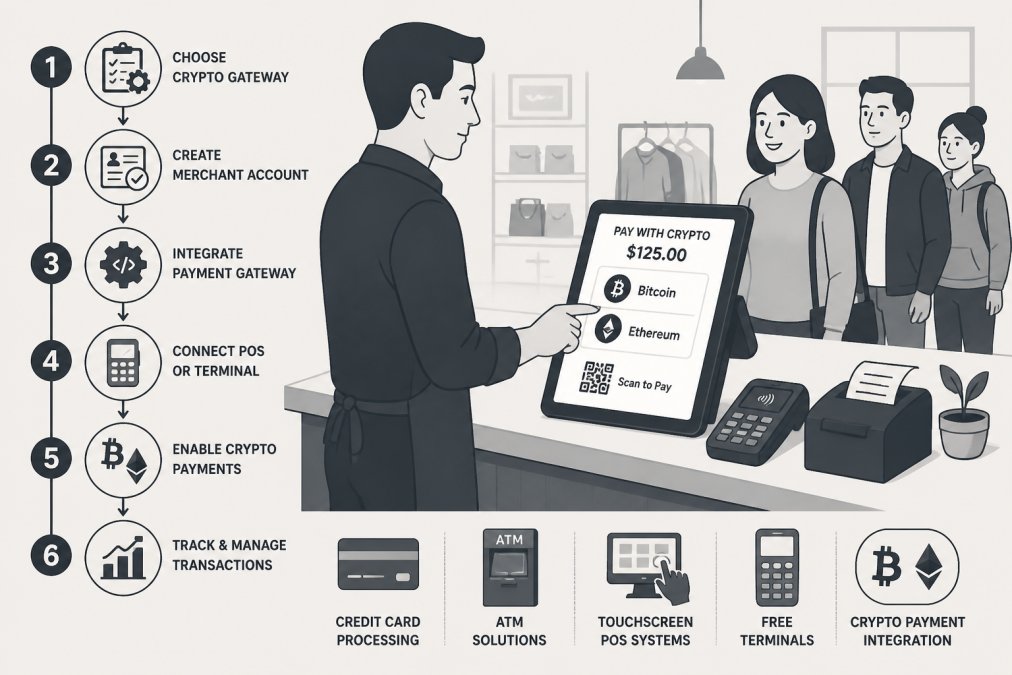
The integration usually takes 1-2 hours. Most processors have step-by-step guides. If you get stuck, call support, that's what they're there for.
Step 3: Configure Your Merchant Dashboard and Settlement Preferences
Your merchant dashboard is mission control. Set it up right and you'll save hours every month.
Settlement preferences. Decide whether to receive crypto or USD for each transaction. Many businesses do a mix: keep 20% in Bitcoin as a hedge, convert 80% to USD for operating expenses.
Wallet configuration. If you're holding crypto, choose between:
- Hot wallet. Online, accessible instantly. Less secure but more convenient. Use for working capital.
- Cold storage. Offline hardware wallet. Secure but slower to access. Use for long-term holdings.
Most small businesses use a hot wallet for daily operations and move excess to cold storage monthly.
Price feeds. Set your conversion rates. Some processors use real-time spot prices. Others let you set a fixed rate. Real-time is simpler but exposes you to volatility between customer payment and settlement.
Refund policy. Decide how you'll handle refunds. Refund in the original crypto? Convert to USD? Set this upfront to avoid confusion later.
Tax reporting. Enable automatic tax record exports. This is critical for IRS compliance (see section below).
Security, Cold Storage, and Transaction Confirmation
Crypto security is different from credit card security. You hold your own keys, which means you're responsible for protecting them.
Private keys and public addresses. Your public address is like an account number, safe to share. Your private key is like your password and PIN combined. Never share it. Anyone with your private key can steal your funds.
Transaction confirmation. Blockchain transactions aren't instant. Bitcoin takes 10 minutes on average. Ethereum takes 12-15 seconds. During this time, the transaction is "pending." Once confirmed, it's irreversible.
Hot vs. cold storage. Hot wallets are connected to the internet. They're fast but vulnerable to hacking. Cold storage (hardware wallets or paper wallets) is offline and secure but slower. Use hot for daily operations, cold for storage.
Best practices:
- Enable two-factor authentication on all accounts
- Use hardware wallets for holdings over $10,000
- Never store private keys in email or cloud storage
- Back up your wallet recovery phrase offline
- Test your backup recovery process once per year
Most processors handle security for you if you use their hot wallet service. But understand the risks. If you're holding significant crypto, invest in a hardware wallet and learn proper key management.
How to Report Crypto Business Income to the IRS
The IRS treats crypto as property, not currency (Digital assets). Every transaction is a taxable event.
What you owe taxes on:
- Revenue from accepting crypto payments (at fair market value on the transaction date)
- Gains if you hold crypto and its value increases
- Interest or yield from staking or lending
How to calculate it. When a customer pays you 1 Bitcoin worth $45,000, you report $45,000 as income. If you later sell that Bitcoin for $48,000, you report a $3,000 capital gain.
Record-keeping. Keep detailed records of every transaction:
- Date, time, and amount in USD
- Customer identity (for large transactions)
- Purpose (payment for goods/services, interest earned, etc.)
- Exchange rate used
- Proceeds if you sold the crypto
Most crypto payment processors export this data automatically. Download it monthly and keep it organized.
Tax forms. You'll report crypto income on your regular business tax return (Schedule C for sole proprietors, Schedule K-1 for partnerships). Capital gains go on Form 8949. If you have more than a few transactions, use tax software designed for crypto to generate compliant reports.
Estimated taxes. If crypto revenue is significant, make quarterly estimated tax payments to avoid penalties. Talk to your accountant about timing.
State taxes. Some states tax crypto transactions separately. Check your state's rules.
The IRS has been aggressive about crypto tax enforcement. Don't skip this step. Penalties and interest add up fast.
Managing Volatility, Refunds, and Chargebacks
Crypto's price swings can hurt your business if you're not careful. Here's how to manage it.
Volatility risk. Bitcoin's price can move 5-10% in a single day. If you accept 1 BTC as payment and the price drops 10% before you convert it to USD, you've lost money.
Solutions:
- Convert to USD immediately (eliminates volatility risk but costs a small fee)
- Use stablecoins like USDC (pegged to the dollar, no volatility)
- Hold a small percentage in crypto as a strategic bet, convert the rest
- Set a price floor, if crypto drops below your threshold, convert immediately
Refunds. Crypto refunds work differently than card refunds. You can't reverse a blockchain transaction. Instead, you send a new transaction back to the customer's wallet.
Set a clear refund policy upfront. Most businesses refund in the original crypto. Some refund in USD at the current exchange rate. Decide and communicate it clearly.
Chargebacks. One of crypto's biggest advantages: no chargebacks. Once a transaction confirms, it's final. A customer can't dispute it or reverse it. This eliminates a major source of fraud and operational headaches for retail businesses.
If a customer claims they didn't authorize a payment, your only recourse is a manual refund (at your discretion). You're not obligated to refund, but good customer service often means you will.
Regulatory Compliance and KYC Requirements
Crypto is regulated, and the rules are tightening. You need to understand what applies to your business.
KYC (Know Your Customer). If you accept crypto payments above certain thresholds, you may need to verify customer identity. Most payment processors handle this automatically.
AML (Anti-Money Laundering). You can't knowingly accept payments from sanctioned entities or use crypto to launder money. Your processor screens transactions against government watchlists.
Merchant account requirements. Your processor will ask about your business. Be honest. They need to know you're not running a gambling operation, selling prohibited items, or engaging in illegal activity.
State regulations. Some states require crypto payment processors to be licensed as money transmitters. Your processor handles this compliance. You don't need a separate license to accept payments.
International transactions.
The regulatory landscape is evolving. Stay informed by checking IRS.gov and FinCEN.gov for updates. Your processor will notify you of major changes that affect you.
Accepting crypto payments is simpler than most business owners think. Start small, add it to your existing payment options and see how customers respond.
DCATMP integrates crypto payments into your existing merchant account with no long-term contracts, no cancellation fees, and 24/7 support. You get one dashboard for all payment types, cards, crypto, and ATM transactions. Request a quote today and see how crypto payments can grow your business.
Frequently Asked Questions
Is it legal for businesses to accept cryptocurrency in the United States?
Yes. The IRS treats cryptocurrency as property, and businesses can legally accept it as payment. However, you must comply with KYC (Know Your Customer) and AML (Anti-Money Laundering) regulations, maintain records for tax reporting, and report income at fair market value on the date received. State regulations vary, so verify local requirements before launching. Most payment processors handle compliance automatically.
How do I convert crypto payments into USD automatically?
Most crypto payment gateways offer automatic fiat conversion through their merchant dashboard. You set your settlement preferences to receive USD directly into your bank account, typically within 24-48 hours. The processor handles the blockchain transaction, conversion at real-time rates, and deposits. This eliminates the need to hold cryptocurrency and protects you from volatility risk.
What are the tax implications of accepting crypto payments?
Report each crypto transaction as income at its USD fair market value on the date received. Keep detailed records including transaction date, amount received, USD equivalent, customer details, and conversion rates. You may also owe self-employment tax. Consult a CPA familiar with crypto taxation to ensure proper reporting to the IRS and avoid penalties.
Do I need a special POS system to accept cryptocurrency?
Not necessarily. Most modern POS systems support crypto payment integration through API connections to payment processors. Your existing e-commerce platform or point of sale terminal can accept crypto if your payment processor supports it. DCATMP offers free POS systems with built-in crypto integration, eliminating the need for separate hardware or software.