 blog
Helcim vs Stripe for Retail: Which Fits Your Store
Last Updated: November 8, 2026
Quick Summary
Helcim vs Stripe for retail comes down to who does the technical work: Helcim is built for storefront merchants who want a register and card reader ready on day one, while Stripe is built for developers who want to write code that moves money. Helcim uses interchange-plus pricing with volume discounts and a free native POS, while Stripe uses flat-rate pricing and requires integration work.
- Helcim uses interchange-plus pricing with automatic volume discounts; Stripe charges a flat rate per transaction.
- Stripe has no native register, so POS software is a separate subscription or custom build.
- Test offline behavior with a handful of sales during a planned outage, then confirm they reconcile.
- RFP.wiki lists Helcim at 3.9 stars from 997 reviews and Stripe at 5.0 stars from 24,735 reviews.
- Migrate in a slow week, export your item catalog first, and test a full day of transactions.
Table of Contents
- Helcim vs Stripe for Retail: How the Two Stack Up
- Helcim vs Stripe for Retail Cost: Interchange-Plus Against Flat Rates
- Helcim Payment Processing Fees and What They Mean at the Counter
- Stripe Retail POS: Developer Power Without a Native Register
- In-Person Checkout, Hardware, and Offline Failures
- Helcim vs Square vs Stripe: Where Each One Wins
- Inventory, Multi-Location Operations, and Migration Realities
- Matching a Processor to Your Store Before You Request a Quote
- Frequently Asked Questions
Helcim vs Stripe for Retail: How the Two Stack Up
Helcim vs Stripe for retail comes down to a simple split: Helcim is built for merchants who want a register and card reader ready on day one, while Stripe is built for teams who want to write code that moves money. The wrong pick usually traces back to one question: who is doing the technical work?
Helcim is oriented toward storefronts with interchange-plus pricing. Stripe is oriented toward developers with flat-rate online processing. Neither is worse. They are answering different questions.
Below, we break down cost, hardware, offline behavior, and multi-location operations so you can match the processor to how your store actually runs. For a broader look at where our own processing fits, see credit card processing.
| Factor | Helcim | Stripe |
|---|---|---|
| Built for | Storefront merchants | Developers and online sellers |
| Pricing model | Interchange-plus with volume discounts | Flat-rate per transaction |
| Native POS | Yes, free | Limited, partner-dependent |
| Setup effort | Low, no coding | Higher, integration required |
| In-person focus | Strong | Secondary |
Helcim vs Stripe for Retail Cost: Interchange-Plus Against Flat Rates
Cost is where the two processors often diverge. Interchange-plus pricing means you pay the card network's interchange rate plus a fixed markup. Flat-rate pricing means one blended rate per transaction regardless of card type. The useful question for a retailer is what each model costs a real store in a real month.
Fit Small Business's Helcim vs Stripe pricing comparison characterizes Helcim as the cheaper option because of interchange-plus pricing and automatic volume discounts, while describing Stripe as an excellent online payment option. That framing holds up for a store running a high volume of debit and basic credit cards, where interchange is low and a flat rate overcharges you. But the framing only holds under specific assumptions, and those assumptions are where retailers get surprised.
A transparent total-cost-of-ownership model. Consider a hypothetical single-location retailer. Your own statement will differ. The point is the structure of the comparison, not the exact cents.
| Cost line | Helcim (interchange-plus) | Stripe (flat rate) |
|---|---|---|
| Processing on $60K monthly volume | Interchange plus a published markup, with volume discounts as monthly volume grows | A single blended rate per successful transaction, plus a separate rate for keyed-in transactions |
| Hardware | Helcim reader supplied; additional readers priced per unit | Stripe Terminal readers purchased per unit (M2 and WisePOS E priced separately) |
| POS software | Native POS included | No native register; POS is a separate subscription or a custom build |
| Chargebacks | Per-dispute fee | Per-dispute fee |
| Add-ons | Invoicing, recurring, and analytics bundled | Invoicing, Billing, and Radar priced as separate products |
| Integration labor | None for the native POS | Developer time to build and maintain checkout |
The processing line is where interchange-plus can be cheaper for some card mixes, while flat-rate pricing can cost more on low-interchange cards. Hardware and software costs can change the overall picture, and a retailer comparing only the processing rate is comparing one line item.
Watch out: the savings from interchange-plus depend on your average ticket and card mix staying stable. Model your own mix from recent statements before assuming any headline rate applies to you.
The perception gap. One contrarian data point worth sitting with: G2's 2026 Helcim vs Stripe Payments comparison says Stripe Payments is rated higher than Helcim for price and cost satisfaction, even though the pricing math often favors Helcim. Perceived value and actual cost are not the same thing, and review scores measure the former. A retailer who values a predictable flat rate and a mature developer ecosystem may rate Stripe higher on cost satisfaction even while paying more per transaction, because the cost they are rating includes the time they did not spend auditing an interchange statement.
For a deeper primer on how these rates stack up, read our guide to credit card processing for small business.
Helcim Payment Processing Fees and What They Mean at the Counter
Interchange-plus pricing separates the fee on a statement into the card network's interchange rate and a processor markup.
One contrarian data point worth sitting with: G2's 2026 Helcim vs Stripe Payments comparison says Stripe Payments is rated higher than Helcim for price and cost satisfaction, even though the pricing math often favors Helcim. Perceived value and actual cost are not the same thing, and review scores measure the former.
Stripe Retail POS: Developer Power Without a Native Register
Stripe is not a register you unbox. It is a set of payment tools and an API that a developer assembles into a checkout flow. Whether that suits you depends on your team.
Helcim's own processor comparison draws the same line, noting that Helcim suits businesses seeking a ready-to-go POS without coding while Stripe suits developers building payments into software. If your store already runs a custom inventory system and you have engineering support, Stripe's flexibility is real. If your "IT department" is the owner with a tablet, Stripe's flexibility is a project.
In-Person Checkout, Hardware, and Offline Failures
In-person payments are central to many retail stores. A card-present transaction that fails during an internet outage can mean a lost sale. It is worth walking through what each processor offers at the counter.

Offline behavior matters. Ask any processor one question before signing: what happens to a card-present transaction when the connection drops?
Test offline behavior before you need it: run a handful of sales during a planned outage, reconnect, and confirm the transactions reconcile in your reporting.
Returns, exchanges, and split tenders. Busy checkout involves more than taking a card: processing returns against original sales, splitting tenders, applying discounts, and sending receipts. Whether these workflows are built in or require development depends on the system you choose.
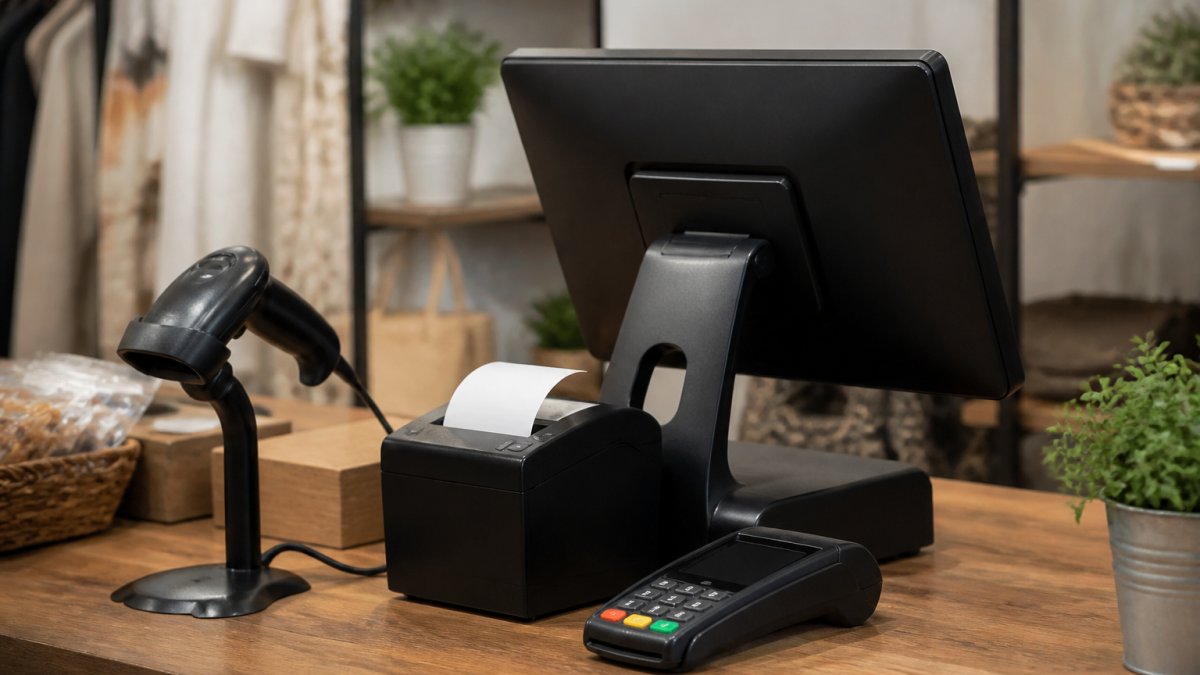
If you want touchscreen POS hardware for checkout, explore our touchscreen POS systems.
Helcim vs Square vs Stripe: Where Each One Wins
Adding Square to the comparison clarifies the field, because the Helcim vs Square vs Stripe question is really about three different bets on who does the work.
For a fuller field of options, see our roundup of the best POS systems for small business.
Inventory, Multi-Location Operations, and Migration Realities
Multi-location retail exposes weaknesses that a single store never sees. Inventory syncing across registers, per-location reporting, and consistent pricing all depend on how tightly the POS and the processor talk to each other.
Migration is the other hidden cost. Switching processors means re-keying inventory, retraining staff, and running parallel systems during cutover. A common mistake is migrating mid-quarter to chase a rate. Do it in a slow week, export your item catalog first, and test a full day of transactions before going live.
RFP.wiki's 2026 Helcim vs Stripe review lists Helcim at 3.9 stars from 997 reviews and Stripe at 5.0 stars from 24,735 reviews, though the review counts and rating methodology differ enough that the scores are not directly comparable. Read the complaints, not the stars.
Matching a Processor to Your Store Before You Request a Quote
The right processor is the one that matches your store's profile, not the one with the best review score. Use this checklist before you commit:
- Do you need a native register, or can you build a checkout?
- What is your average ticket and card mix?
- What happens during an internet outage?
- How many locations, and does inventory sync across them?
- Who owns the hardware, and what does replacement cost?
- What are the contract terms and cancellation fees?
DCATMP offers no long-term contracts, no cancellation fees, and no upfront equipment costs for qualifying businesses, along with free terminals, touchscreen POS systems, and 24/7 support. DCATMP also supports crypto payments with settlement in USD. If you are ready to see what that looks like for your store, request a quote and we will map it to your volume.
The processor you pick will handle many transactions before you review the decision again. Get the offline behavior, the hardware ownership, and the contract terms right before you sign. DCATMP offers free POS hardware for qualifying businesses, no long-term contracts or cancellation fees, and 24/7 support. Get started with DCATMP and build a checkout that keeps running when the internet does not.
Frequently Asked Questions
Is Helcim cheaper than Stripe for retail businesses?
Interchange-plus pricing can reward stores with steady card-present volume, since the markup over interchange may be thin and can shrink as volume grows. Stripe's flat-rate structure is simpler to forecast but may cost more per swipe for some card mixes. Run your own monthly card volume through both models before deciding, and remember that total cost also includes hardware, gateway fees, and chargeback handling.
What percentage does Helcim take on in-person transactions?
Helcim uses interchange-plus pricing, so the effective percentage on a card-present transaction depends on the card type, the issuer, and your monthly volume rather than a single published rate. The effective rate depends on your specific volume and card mix. Ask for a quote based on your actual card mix, because rewards cards and keyed-in transactions cost more than basic debit swipes. Compare the quoted effective rate against your current statement.
Can Helcim and Stripe both handle in-person and online retail sales?
Both can, but the emphasis differs. Helcim offers a POS and card readers for counter checkout alongside online payments. Stripe is commonly used by developers embedding payments into software, so online checkout and custom integrations are typically its strength. A store selling in both channels should map which system owns inventory and reporting before choosing, since split systems create reconciliation work at month end.
Which is easier to use for a small retail business, Helcim or Stripe?
Helcim is the simpler path for a store that wants to open a register and start swiping, because its POS is designed to work without custom code. Stripe assumes some technical setup or a POS partner to handle the counter experience. Ease of use for your staff matters more than aggregate ratings, so trial the checkout flow before committing.