 Listicle
Why an In-Store ATM Pays Off for Retail Businesses
Last Updated: November 10, 2026
Quick Summary
An in-store ATM lets customers withdraw cash on site while generating surcharge income and reducing card-processing fees for the owner. It also lifts foot traffic, dwell time and basket sizes, but it brings cash loading, maintenance, security and space burdens you must weigh first.
- At 30 withdrawals a day at a $3.00 surcharge, gross surcharge revenue is about $2,700 a month.
- The surcharge is not pure profit: network and processing costs come out before settlement.
- Placement or revenue-share deals give you a smaller per-transaction share but leave cash loading and repairs to the operator.
- Daily visual inspections of the card slot and keypad are a core skimming defense.
- A standard placement is usually completed in a single visit once the location is approved.
Table of Contents
- How an In-Store ATM Turns Foot Traffic Into Revenue
- ATM Advantages and Disadvantages Every Owner Should Weigh
- How Much Does an ATM Make in a Month for a Store?
- ATM Fees for Store Owners: Who Pays and Who Collects
- In-Store ATM Installation: What the Process Looks Like
- Where Cash Access Lifts Sales, Spending and Loyalty
- Security, Fraud and Operating Risks to Plan For
- Request a Free ATM Placement Quote From DCATMP
- Frequently Asked Questions
How an In-Store ATM Turns Foot Traffic Into Revenue
An in-store ATM is a self-service cash machine placed inside a retail business that lets customers withdraw cash on site while generating surcharge income and card-processing savings for the owner.
The cash-recycling segment alone grew from 973,000 units deployed globally in 2020 to more than 1 million in 2021, according to Brink's ATM Managed Services research on ATM trends. Meanwhile, IMARC Group's U.S. ATM market analysis put the domestic market at USD 9.0 billion in 2026, with a projection of USD 12.7 billion by 2034.
Here is the throughline: an ATM is not a vending machine that prints money. It is a cash-access point that changes how customers pay, how much they spend, and what you pay in card fees.
ATM Advantages and Disadvantages Every Owner Should Weigh
The drawbacks are equally concrete: cash loading, downtime, security exposure, and space.
Advantages:
- Surcharge income on every withdrawal, often the most predictable revenue line
- Higher ticket sizes when customers have cash in hand
- Reduced credit card processing fees when more transactions settle in cash
- Foot traffic and dwell time from non-shoppers who come in just to withdraw
Disadvantages:
- Cash replenishment logistics, unless your operator handles it
- Maintenance and repair downtime during business hours
- Security and fraud exposure, from skimming to chargebacks
- Floor space and power requirements
An ATM rewards stores with steady foot traffic and punishes stores with thin, unpredictable volume. A rural gas station with 400 daily customers and a downtown boutique with 40 are not the same decision.
How Much Does an ATM Make in a Month for a Store?
Monthly gross surcharge revenue depends on transaction volume and surcharge rate. That is the top line. The number that matters is net return after processing, cash logistics, maintenance, connectivity, and any revenue split, and the gap between the two is where owners get surprised.
What Drives Monthly ATM Income
Three variables decide your gross monthly figure:
- Withdrawal volume. How many customers use the machine per day, which tracks your foot traffic and nearby cash demand.
- Surcharge rate. What you charge per transaction. Higher rates earn more per withdrawal but suppress usage.
- Your revenue split. Whether you own the machine outright, lease it, or take a share from a placement operator.
Do the math before you sign. If your machine averages 30 withdrawals a day at a $3.00 surcharge, that is about $2,700 a month in gross surcharge revenue. At 10 withdrawals a day, it is $900. Same machine, same store, very different business.
A Transparent Cost and Revenue Breakdown
Gross surcharge revenue is not take-home. Build your estimate from both sides of the ledger.
Revenue side (monthly):
- Gross surcharge income: withdrawals per day x surcharge x operating days. At 30 withdrawals a day, a $3.00 surcharge, and 30 days, that is $2,700.
- Any interchange or network share your agreement routes back to you, if you own the machine.
Cost side (monthly, typical ranges):
- Processing and network fees. A per-transaction cost is deducted before settlement. At 900 transactions a month, even a modest per-transaction fee adds up.
- Cash loading and armored service. If a carrier replenishes the machine, expect a per-visit or per-stop charge plus a percentage of cash moved. Stores that load cash themselves avoid the fee but take on the labor and risk.
- Maintenance and repair. Under a service contract, a predictable monthly fee; without one, repairs are episodic and can exceed a year of contract fees in a single breakdown.
- Connectivity. A dedicated phone line or wireless data plan, typically a small but recurring monthly cost.
- Equipment. Owning means a capital outlay or financing payment; leasing means a fixed monthly lease; placement means no equipment cost but a revenue split.
A worked example. Take the $2,700 gross month. Subtract processing at roughly 900 transactions, a cash-loading visit or two, a maintenance contract, connectivity, and insurance. Direct operating costs reduce gross surcharge income, and the remainder is what you either keep or split with an operator.
The Sales-Lift Claim: What It Is and What It Is Not
Test any claimed sales lift in your own location: compare basket size and average transaction value for cash-paying customers before and after installation. If a vendor quotes a hard percentage as a promise, ask for the study, the sample, and the store types it covered.
For a fuller walkthrough of realistic earnings and the drivers behind them, see our guide to passive income from ATM machines.
ATM Fees for Store Owners: Who Pays and Who Collects
Store owners collect the surcharge; the customer pays it at the terminal. The longer version involves three parties, a settlement process most owners never see, and a choice of operating model that determines who carries the cash, the repairs, and the compliance burden.
- The customer pays the surcharge on top of their withdrawal, disclosed on screen before the transaction completes.
- The store collects the surcharge, either keeping it or splitting it with the operator depending on the agreement.
- The operator or processor handles the network interchange, cash reconciliation, and settlement to your account.
Watch out: the surcharge is not pure profit. Network and processing costs come out before settlement, and a revenue-share deal can cut your take significantly. Our ATM processing overview explains how settlement and surcharge collection actually flow.
Choosing an Operating Model: Own, Lease, or Placement
The fee question and the operating-model question are the same question. Who collects the surcharge depends on who owns the machine and who carries the risk.
Own the ATM. You buy the machine and keep the surcharge after processing costs. You also carry cash loading, maintenance, connectivity, insurance, and compliance.
Placement or revenue-share. An operator owns and services the machine, and you receive a share of surcharge revenue or a flat monthly fee.
Who Handles What Under Each Model
| Responsibility | Own | Lease | Placement / Revenue-Share |
|---|---|---|---|
| Equipment cost | You | Fixed lease | Operator |
| Cash loading | You or carrier | You or carrier | Operator |
| Repairs and maintenance | You | You or contract | Operator |
| Connectivity | You | You | Usually you |
| Skimming and fraud response | You | You | Operator, with your cooperation |
| Surcharge collection | You keep after costs | You keep after costs | Split per agreement |
| Compliance and reporting | You | You | Operator |
The placement model generally offers simplicity, while ownership can offer more margin at high volume. The mistake is choosing ownership for a location that cannot support the cash-loading and maintenance workload.
Questions to Ask Before You Sign
- What is the exact per-transaction split, in writing?
- Who loads cash, how often, and who pays for the carrier?
- What is the repair response time, and who pays for parts and labor?
- Who is responsible for skimming inspections and fraud losses?
- What are the termination terms, and are there cancellation fees?
A partner who answers all six clearly is worth more than one who quotes the highest surcharge. For a deeper look at the revenue mechanics, read how to earn passive income with an ATM.
In-Store ATM Installation: What the Process Looks Like
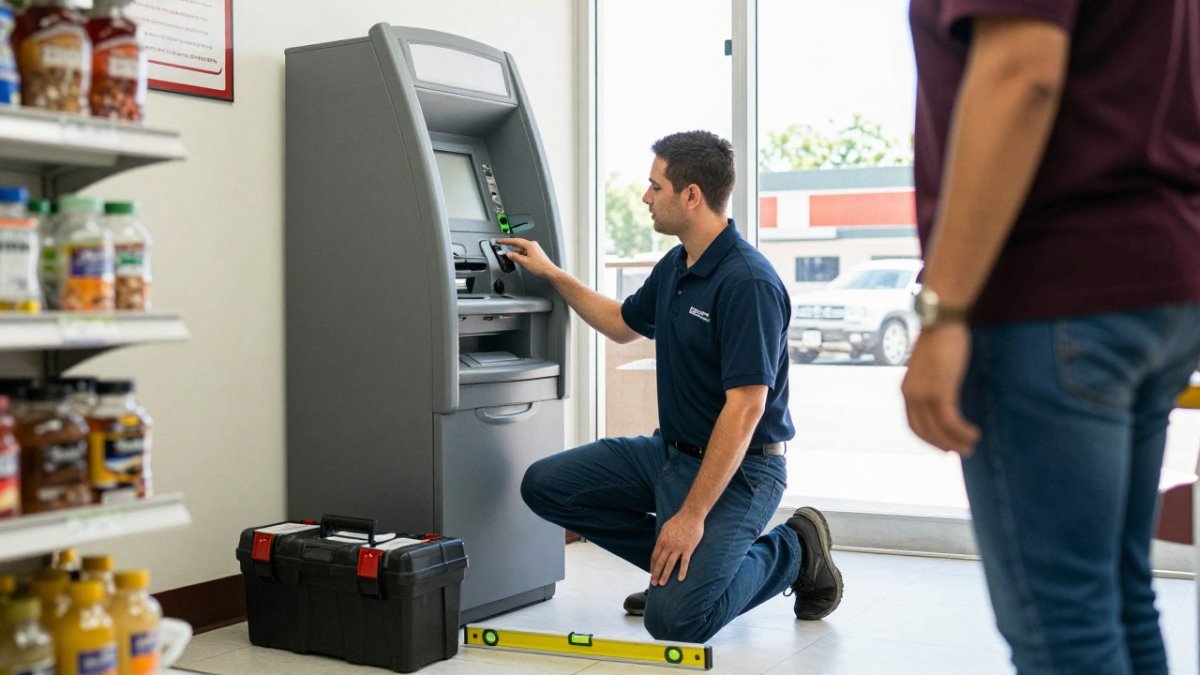
Installation is faster than most owners expect. A standard placement takes a site survey, a power and network drop, mounting or counter placement, cash loading, and a test transaction cycle, usually completed in a single visit once the location is approved.
Space, Power and Network Requirements
For details on free ATM placement, see our free ATM placement page.
Where Cash Access Lifts Sales, Spending and Loyalty
Cash access can change buying behavior, and the effect is often largest where cash is already preferred.
The mechanism is straightforward. A customer who withdraws $60 at your machine has $60 to spend, and often spends part of it before leaving. That impulse purchase effect shows up in basket spend and average transaction value.
Two caveats. First, spending-lift claims are directional, not guaranteed; published figures vary widely by location type, and no credible study promises a fixed percentage across all retail. Second, the loyalty benefit compounds only if the machine stays stocked and online, a dead ATM damages trust faster than no ATM at all.
For a deeper look at the revenue mechanics, read how to earn passive income with an ATM.
Security, Fraud and Operating Risks to Plan For
An ATM introduces real risk, and owners who ignore it pay for it twice. Skimming devices, card trapping, physical break-ins, and cash-handling errors are the four most common exposures.
Mitigations that actually work:
- Daily visual inspections of the card slot and keypad for overlays
- Tamper-evident seals on cash cassettes and service panels
- Camera coverage aimed at the terminal and the customer's hands
- Reconciliation checks against expected withdrawal counts
- A written downtime protocol so staff know who to call and when
The operating model matters here too. Under a placement arrangement, the operator typically carries cash loading, maintenance, and much of the service burden, removing a large share of your exposure.
This is also where the choice of partner separates good deals from bad ones. A partner with 24/7 support keeps your machine earning.
Request a Free ATM Placement Quote From DCATMP
The decision comes down to three questions: does your foot traffic support the machine, which operating model fits your risk tolerance, and what does the split actually look like after costs. Answer those and the rest is logistics.
At DCATMP, we place ATMs at no upfront cost for qualifying businesses, with full installation, maintenance, and repair handled by our team.
Get started with DCATMP and turn your counter space into a cash-access point that pays you back. Request a quote and we will walk your location and give you a straight answer.
Your store already has the traffic. The question is whether that traffic leaves with cash in hand or walks out to find an ATM down the street.
Frequently Asked Questions
What are the main benefits of an in-store ATM for a retail business?
An in-store ATM gives customers cash access on site, which supports cash-only purchases and can raise basket spend. It can also earn surcharge revenue, cut card processing costs when more shoppers pay in cash, and increase foot traffic from people who stop in just to withdraw. The size of each benefit depends on your location, daily traffic and the surcharge you set. Retailers should measure transaction counts and average ticket before and after installation rather than assume a fixed sales lift.
How much does an ATM make in a month for a store owner?
Monthly income depends on how many withdrawals the machine handles and the surcharge per transaction. A machine with steady foot traffic and a competitive surcharge will earn more than one in a low-traffic spot. Under a placement model, the store typically receives a share of surcharge revenue rather than the full amount. Track transaction volume for the first 60 to 90 days, then compare that figure against the terms of your placement or ownership agreement.
Who pays ATM fees for store owners, and does every machine charge one?
The customer withdrawing cash usually pays the surcharge, which the store or operator collects. Some ATMs sit in surcharge-free networks, so the user pays nothing and the store earns no surcharge on that transaction. Your own bank may also charge an out-of-network fee, which goes to the bank, not the store. Before signing, confirm the surcharge amount, who sets it, and whether the machine participates in any surcharge-free network.
Is in-store ATM installation complicated, and what space does it need?
Installation is straightforward when the site is prepared. The main planning items are keeping the machine visible from the entrance, leaving room for a queue, and positioning it where staff can see it. Ask your provider to confirm power and connectivity needs before the install date.